
How Loud Should a Master Be? Loudness for Streaming, YouTube and Vinyl
Every band wants their songs to sound as loud and powerful as the records they love. Streaming services publish loudness targets, and the internet is full of advice to master to −14 LUFS. For rock and metal, that advice leads to weak results – here's why, and what to aim for instead.
LUFS in two minutes
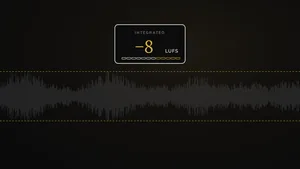
Loudness is measured in LUFS (Loudness Units relative to Full Scale). Unlike a peak meter, which shows the highest sample, LUFS measures how loud the music feels to the ear over time. The number that matters for streaming is integrated LUFS: the average loudness of the whole track. The closer to zero, the louder – so −8 LUFS is much louder than −14 LUFS.
The other number is true peak (dBTP): the highest point of the waveform, including the peaks between the samples that appear when the audio is converted back to analogue or encoded to a streaming format. A master can peak at −0.1 dBFS on your meter and still go over 0 dBTP when it's turned into MP3, AAC or Ogg – and that's where distortion creeps in.
Streaming services turn loud masters down
Most streaming services use loudness normalization: they measure every track and adjust the playback volume so that songs play at roughly the same level. Approximate reference levels:
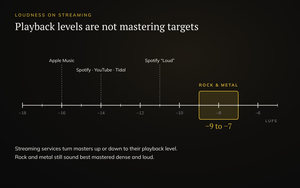
- Spotify: −14 LUFS by default (premium listeners can choose −11 or −19)
- YouTube: about −14 LUFS – loud tracks are turned down, quiet ones aren't turned up
- Tidal and Amazon Music: about −14 LUFS
- Deezer: about −15 LUFS
- Apple Music: about −16 LUFS with Sound Check
These are playback levels, not mastering targets. Only Spotify publishes its figure officially – the others are measured values and can change. And normalization doesn't always apply: Spotify's web player and many third-party devices don't use it, listeners can switch it off, and YouTube only turns loud tracks down, never quiet ones up.
Why −14 LUFS is the wrong target for rock and metal
Spotify suggests mastering to −14 LUFS. Do that with a heavy record and you'll usually end up with a master that sounds small and polite next to the albums it competes with. Dense, distorted music is loud by nature: a wall of guitars, a busy kick drum and a screaming vocal leave little room between the average level and the peaks. Most rock and metal masters land somewhere around −9 to −7 LUFS – that's where the genre sounds right: powerful, dense and in your face.
Yes, Spotify turns an −8 LUFS master down by about 6 dB. But a well-made loud master doesn't lose its impact when it's turned down – it still sounds dense and full at the same playback level, where a −14 LUFS version of the same song often sounds thinner and less exciting.
The real skill is getting a master that loud without it falling apart: no audible distortion or pumping, drums that still hit, a low end that stays tight. Loud on its own isn't the goal – loud and good is.
Why loudness still matters when everything is normalized: is the loudness war over?
What heavy records actually measure
Loudness figures for commercial releases are rarely published, but the Dynamic Range Database collects measurements of thousands of albums made with the TT Dynamic Range Meter. DR shows how far the peaks stand above the loud parts of the music – the lower the number, the denser and louder the master. A selection of death metal, black metal and rock:
Death and black metal
| Album | Year | DR (CD / download) | DR (vinyl) |
|---|---|---|---|
| Unleashed – Where No Life Dwells (1995 pressing) | 1991 | 12 | – |
| Gorgoroth – Pentagram (original release) | 1994 | 12 | – |
| Morbid Angel – Covenant | 1993 | 9 | – |
| Morbid Angel – Domination | 1995 | 7 | – |
| Emperor – Anthems to the Welkin at Dusk | 1997 | 7 | – |
| Marduk – Panzer Division Marduk | 1999 | 6 | – |
| Gorgoroth – Pentagram (2007 reissue) | 1994 | 5 | – |
| Behemoth – The Satanist | 2014 | 5 | 11 |
| Gorgoroth – Instinctus Bestialis | 2015 | 5 | – |
| Emperor – In the Nightside Eclipse (2017 reissue) | 1994 | 6 | 11 |
| Behemoth – Opvs Contra Natvram (download) | 2022 | 6 | – |
| Behemoth – The Shit Ov God (download) | 2025 | 6 | – |
Rock
| Album | Year | DR (CD / download) | DR (vinyl) |
|---|---|---|---|
| David Bowie – “Heroes” (1991 CD) | 1977 | 12 | – |
| Foo Fighters – The Colour and the Shape | 1997 | 7 | – |
| Madrugada – Industrial Silence | 1999 | 8 | – |
| Foo Fighters – There Is Nothing Left to Lose | 1999 | 5 | 12 |
| David Bowie – Heathen (download) | 2002 | 11 | – |
| Madrugada – The Deep End | 2005 | 6 | – |
| Madrugada – Madrugada | 2008 | 7 | 11 |
| Foo Fighters – But Here We Are | 2023 | 5 | 11 |
The pattern is clear. Death and black metal from the early nineties measures around DR9–12, while the heavy records of the last 25 years – Behemoth, Marduk, Gorgoroth, the Emperor reissues – sit around DR5–7. Gorgoroth's Pentagram shows it best: the original release measures DR12, the 2007 reissue DR5. Same album, much louder master.
Rock follows the same curve, just a little less extreme. Foo Fighters land at DR5–7 and Madrugada at DR6–8, while Bowie's Heathen is a rare exception at DR11. And notice the vinyl versions: the same albums measure DR11–12 on vinyl, partly because vinyl is usually cut from a separate, less limited master.
But louder isn't the same as better. A low DR number only tells you how dense a master is, not how good it sounds – and some of the loudest masters out there are clearly overcooked: flattened drums, harsh distortion and tired ears after three songs. The art is to master loud and still keep it punchy and clear, not squashed and distorted. It's not easy, and it's a big part of what good mastering is about.
DR values from the Dynamic Range Database (dr.loudness-war.info). The year is the album's original release year. Different pressings and remasters of the same album can measure differently.
Practical guidelines for streaming
- Master to the genre, not to a platform target. For rock and metal, around −9 to −7 LUFS is normal. Compare your master with records you like in the same genre, at the same perceived volume – most meters and DAWs can loudness-match.
- One master for every streaming service. Normalization takes care of the playback level – you don't need separate versions for Spotify, Apple Music and YouTube.
- Listen after encoding. Hot masters can distort when they're turned into MP3, AAC or Ogg. Check your master through a codec preview and pull the ceiling down if you hear it break up.
- Keep the quiet songs quiet. On an album, an acoustic interlude or a ballad should stay quieter than the heavy songs. Several services can normalize a whole album as one and keep those level differences.
Vinyl is a different story
Vinyl has no normalization – the listener sets the volume. Here, the limits are physical: the louder the cut and the more low end, the wider the grooves, and the less music fits on a side. Long sides have to be cut quieter. Harsh highs and sibilance can distort on playback, and out-of-phase low end can make the cut difficult and the needle skip.
So a vinyl master is usually made separately: less limited, with controlled highs and mono low end, and split into sides that fit. Don't send your streaming master to the pressing plant – ask for a vinyl master.
CD has no normalization either, and the loudness is whatever the master is. A DDP file is the safest way to deliver it to the plant.
What to send your mastering engineer
A mix with some headroom and no limiter on the mix bus, at the session's sample rate and 24-bit or higher. If you love the sound of your limited version, send it along as a reference – it shows the engineer the energy you're after. Read more about what mastering is and what it costs, or see how I master for streaming, vinyl and CD.
Step by step: how to export a mix for mastering.
Got a release coming up? Send me your mixes.
Further reading
- ITU-R BS.1770 – the standard behind LUFS measurement
- Bob Katz, Mastering Audio: The Art and the Science (Focal Press)
- Bobby Owsinski, The Mastering Engineer's Handbook
- Dynamic Range Database, dr.loudness-war.info