
Is the Loudness War Over? No – It Just Changed
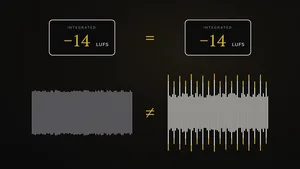
Ever since streaming services started turning loud masters down, people have been declaring the loudness war over. It isn't. It has changed: the fight is no longer about who has the highest average level, but about who sounds loudest and punchiest when everything plays at the same volume.
The old loudness war
For decades, louder meant better. On the radio, in the CD changer, in the record shop – the louder song grabbed your attention first. But a digital master can't go above 0 dBFS, so the only way to get louder was to push the average level (RMS) closer to the peaks: more compression, more limiting, more clipping. Through the nineties and 2000s, CDs got louder and flatter, until some masters were so crushed that they audibly distorted. Metallica's Death Magnetic from 2008 became the textbook example.
You can follow the curve in the numbers: in how loud should a master be, there are examples of death metal, black metal and rock albums measured before and after the loudness war took off.
Then streaming turned the volume down
Streaming services now measure every song in LUFS and adjust the playback volume, so that songs play at roughly the same level. On YouTube, normalization can't be switched off, and loud songs are only turned down, never up. Spotify, Tidal and Amazon Music normalize by default, and in 2022 Apple switched Sound Check to LUFS and turned it on by default on new devices. Master a song to −7 LUFS, and Spotify plays it about 7 dB quieter at its default setting.
That's why well-known mastering engineers declared the war over. Bob Katz expected it to end by 2014, and Ian Shepherd wrote that YouTube's normalization put the last nail in its coffin. In 2024, Shepherd admitted that he had been too optimistic: mainstream releases still regularly land at −8 LUFS or louder.
Why it isn't over
- Not everything is normalized. CDs, Bandcamp, SoundCloud, most browser players and DJ software play the file as it is. In 2023, YouTube Music only turned songs down when they were louder than −7 LUFS. Shepherd estimates that about one in five listeners hears music without normalization.
- The people making the music switch it off. In Shepherd's informal poll, more than three out of four artists, engineers and producers said they disable normalization – while only around 17 % of ordinary listeners do. So a lot of decisions are made listening at levels most fans never hear.
- Normalization only levels the measurement. LUFS is a model of how loud something sounds, and a good one, but not a perfect one. Two songs at exactly −14 LUFS can sound very different in loudness and impact.
The new war: perceived loudness at the same level
When everything plays at the same measured level, the question changes from "how loud is your master?" to "how loud does it sound next to everything else?" And there the differences are still big. Put on a playlist with normalization switched on, and some songs still jump out of the speakers – bigger, clearer and harder-hitting than the song before. The race for the highest RMS is over. The race for perceived loudness isn't.
What makes a master sound louder at the same LUFS
Midrange and the vocal
Our ears are most sensitive in the upper midrange, and we judge loudness by what we focus on – usually the vocal. A clear, present vocal and guitars that cut through make a song sound louder than a dull, muffled mix with the same reading.
How the meter hears
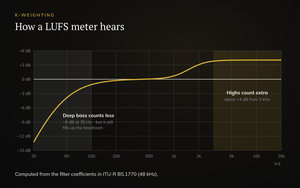
A LUFS meter doesn't hear like you do. It uses a filter called K-weighting: the deep lows count less – at 30 Hz about 8 dB less – and the highs count extra, about 4 dB from 3 kHz and up. Fizz and harshness push the reading up and get the song turned down further, without making it sound better. Too much sub-bass fills up the headroom, so the limiter has to work harder, without making the song sound much louder. A balanced top end and a controlled low end give you more perceived loudness for every LUFS.
Contrast between sections
Integrated LUFS is an average of the whole song. A song with quieter verses and an explosive chorus gets turned down less than one that's flat out from start to finish – so its chorus lands harder. Contrast is what makes the loud parts sound loud.
Transients
At the same playback level, a master that has kept its transients has kick and snare hits that stand clearly above the rest of the music. That's what we hear as punch. When a crushed master is turned down, nothing sticks out any more – it just becomes a smaller wall of sound.
Density from the mix, not from the limiter
Saturation, parallel compression and controlled clipping on drums and buses build density and energy that survive normalization. The last couple of dB squeezed out of the master limiter rarely do: they cost punch, and when the song is turned down, there's nothing left of them.
What it means for rock and metal
This isn't an argument for quiet masters. Heavy music is dense by nature, and a good rock or metal master still lands around −9 to −7 LUFS – partly because density is part of the sound, partly because a lot of people still hear it without normalization. Read more in how loud should a master be. The difference is how you get there: the loudness has to come from the mix and the arrangement, so the master still sounds big and punchy when it's turned down to −14.
The test is simple. Loudness-match your master with the records you're up against – most meters and DAWs can do it – and listen. Which one sounds bigger, clearer and hits harder at the same level? That's the war worth winning.
Want your release to hold its own next to the records you love – at any playback level? Read more about mastering at Black Sun Audio and what mastering is and what it costs, or send me your mixes.
Further reading
- Ian Shepherd, Why the Loudness War Still Isn't Over (Production Expert, 2024)
- Ian Shepherd, Production Advice (productionadvice.co.uk)
- ITU-R BS.1770 – the standard behind LUFS measurement
- Bob Katz, Mastering Audio: The Art and the Science (Focal Press)