
Studio vs. Home Recording: What's Worth Paying For?
Home recording has never been better. A decent audio interface, a laptop and a few plugins can capture guitar, bass and synth tracks that hold up on a real release. So why pay for a studio at all? Because some things are still very hard to do well at home – and knowing which ones is the key to spending your budget wisely.
What can work well at home
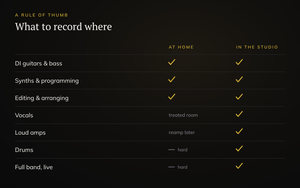
- DI guitars and bass. A clean DI recorded through a good instrument input can be reamped or run through amp simulators later. Get the playing and the levels right, and the result is as good as anything recorded in a studio.
- Synths, keyboards and programmed parts. They go straight into the computer – no room, no microphones.
- Editing and arranging. Trying out parts, comping takes and building the song at your own pace, without paying by the hour.
- Demos and guide vocals. Perfect for writing and pre-production.
With some skills and care, you can definitely get very good results at home. What you might miss out on is the perfect take, someone guiding you through the session, and a producer's or engineer's tips on making the song as good as it can be.
What's hard at home
- Drums. A drum kit needs a good-sounding room, a lot of microphones, enough inputs and a place where you can play loud for hours. The drums are also the foundation of the whole recording – weak drum sounds are very hard to fix in the mix.
- Loud amps. A cranked tube amp in a bedroom annoys the neighbours, and a small untreated room rarely sounds good on a microphone.
- Vocals. A good microphone in an untreated room records the room too: reflections and a boxy sound that no plugin fully removes. A wardrobe full of clothes helps; a treated vocal booth helps more.
- The whole band at once. A live take needs separation, lots of inputs and a headphone mix for everyone.
- An outside ear. At home, nobody tells you that the last take was the best one – or that the tempo is too fast.
The hidden costs of recording at home
Home recording isn't free. Microphones, an interface with enough inputs, acoustic treatment, monitors and plugins add up quickly – and so do the hours spent learning to use them instead of playing. That's time and money that could also go into a few days in a studio, where the gear and the room are already sorted and someone's only job is to get a great take out of you.
The best of both: a hybrid recording
Many bands now split the work:
- Record the drums in the studio, where a good room and good microphones make the biggest difference.
- Record guitars and bass as DI at home, at your own pace, and have them reamped or processed in the mix.
- Record the vocals wherever they sound best – in the studio, or at home if you have a quiet, treated space.
- Send everything to one engineer for mixing and mastering, so the whole record sounds like one piece.
Can't bring the drums to the studio? A mobile setup can come to your rehearsal space instead. At Black Sun Audio, a full studio day costs 2800 DKK / €375, and recording on location up to 80 km from Aarhus 4500 DKK / €602 per day – see all prices.
How to decide
- If the drums are acoustic and the record matters, record them in a studio.
- If you have the skills and the time, record DIs and overdubs at home – it saves studio days.
- If your vocals sound boxy at home, book a studio day for them.
- If you're not sure, record a demo at home first – it's the best preparation for the studio anyway.
Planning a session? Read how to prepare your band for a studio recording, check out recording at Black Sun Audio – or get in touch and tell me about your project.
Further reading
- David Franz, Recording and Producing in the Home Studio (Berklee Press)
- Mike Senior, Recording Secrets for the Small Studio (Focal Press)