
What's the Best Microphone for Death and Black Metal Vocals?
Ask ten producers which mic is best for growls and shrieks and you'll get ten answers. Here's mine, after years of recording extreme vocals: the microphone matters far less than the performance – and the mics that serve the performance best are often the cheapest ones in the studio.
The performance comes first
A great extreme vocal is a physical thing. Growls, screams and shrieks come from the whole body, and most vocalists deliver them best the way they do on stage: standing, moving, holding the mic, leaning into it. Put the same vocalist in front of a fixed condenser behind a pop filter and ask them not to move, and the take often loses its edge. No microphone can add the aggression, timing and conviction that aren't in the performance.
That's why a handheld dynamic mic – a Shure SM58 or SM57 – can do a lot for an extreme vocal. The vocalist is on familiar ground, can control the distance to the mic just like live, and stops thinking about being recorded. Let them hold the mic, stand where it feels right and perform.
SM57 or SM58?
They're close relatives: according to Shure, the SM57 has essentially the same capsule as the SM58. The SM58's ball grille has a built-in pop filter and makes it easy to hold; the SM57 has a smaller, more open head and sounds a touch more direct. Both handle extreme sound pressure without complaint, and both cost a fraction of a studio condenser. One tip: don't cup the grille with your hand unless you want that sound – covering it changes both the tone and how much of the room the mic picks up.
The SM7B for deep growls
The Shure SM7B is the classic studio choice for death metal growls. It's a dynamic mic too, but with a smoother top end and a full low end that suits deep, guttural vocals and tames the harshness of high screams. Gojira's Joe Duplantier has said that he uses an SM7 in the studio, and according to producer Logan Mader, the vocals on Gojira's “Flying Whales” were recorded with an SM7B.
The SM7B has one catch: it's a low-output mic and needs a lot of clean gain. Use a preamp with plenty of headroom – or an inline booster – rather than cranking a cheap interface to its limit.
Why dynamic mics win in an untreated room
Dynamic mics like the SM57, SM58 and SM7B are less sensitive than condensers and are used right at the mouth, so they pick up far less of the room – the reflections from the walls, the boxiness of a small space, the noise of the computer fan. A large-diaphragm condenser hears all of it. In a great-sounding, treated room, that can be a good thing; in a bedroom or a rehearsal space, it isn't.
And it gets worse in the mix. Extreme vocals are usually compressed and limited hard to sit on top of distorted guitars and blast beats. Every decibel of compression brings up the room along with the voice, so the reflections that were barely audible on the raw track turn into a boxy, hollow sound around the vocal. Start with as little room as possible – and a dynamic mic close to the mouth is the easiest way to get there.
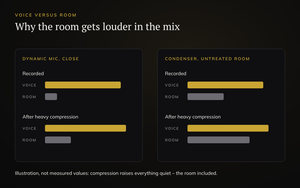
That's also why many big studios do use expensive condensers on metal vocals: in a well-treated room, the extra detail of a condenser isn't a problem. Death metal producer Erik Rutan, for example, has named a Neumann U87 as his main vocal mic. The room makes the difference.
So: no need for an expensive condenser
For growls, screams and black metal shrieks – especially outside a treated studio – you don't need to spend a fortune on a large-diaphragm condenser. A good old SM57 is your friend for extreme vocals – or an SM58 if you prefer the ball grille, and an SM7B if you want a smoother, fuller growl. Put the money into a decent preamp, a sturdy mic stand and, above all, rehearsal time.
Tips for tracking extreme vocals
- Keep the mic a few centimetres from your mouth at a consistent distance – back off a little on the loudest parts
- Set the gain for the loudest scream, not the average – leave headroom and never clip
- Warm up properly and drink water; take breaks before your voice gets tired
- Record several full takes and comp the best parts, rather than punching in word by word
- Monitor with a little reverb in the headphones if it helps you perform – it isn't recorded
- Use the SM58's grille or a foam windscreen if plosives are a problem
Recording vocals at Black Sun Audio? There are SM57s, an SM58 and an SM7B ready in the studio – see the studio's gear. Also read how to prepare your band for a studio recording, or get in touch.
Further reading
- Mike Senior, Recording Secrets for the Small Studio (Focal Press)
- Bobby Owsinski, The Recording Engineer's Handbook